


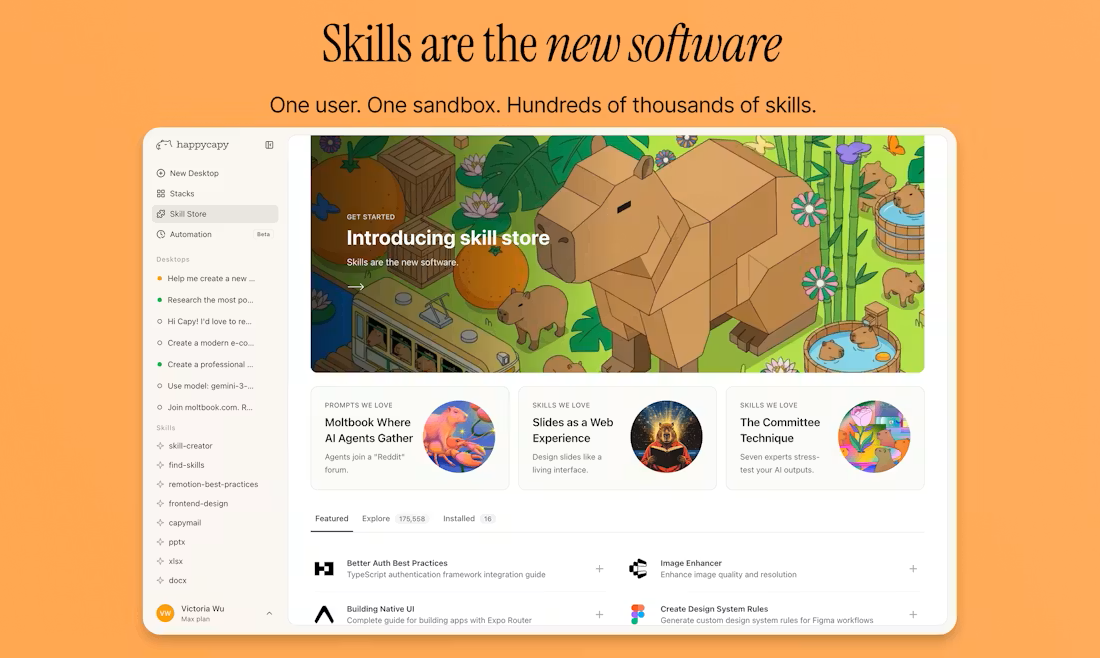

Happycapy
Happycapy is a browser-based AI workspace that aims to make “agent-native computing” accessible to everyday users. Instead of requiring setup-heavy automation tools or developer-oriented workflows, it focuses on letting people run AI agents directly inside a simple interface and get real tasks completed with minimal friction.
The product runs in the browser and is also available on mobile, which makes it feel closer to a universal workspace rather than a specialized developer tool. The idea is that users don’t need to think about infrastructure, configuration, or integration layers—they just express what they want done, and the system handles the execution through AI agents powered by models like Claude Code.
What the experience feels like
Rather than acting like a traditional chatbot, Happycapy is structured more like an execution environment. You interact with AI agents that can perform multi-step tasks, and the interface is designed so that those actions feel visible and manageable without exposing underlying complexity.
Instead of switching between different tools for planning, execution, and output, everything happens inside one continuous workspace. The emphasis is less on prompting and more on delegation—deciding what you want done and letting the agent carry it through.
Why it exists
Most AI agent products tend to fall into two extremes. On one side are developer-focused systems that are powerful but require setup, configuration, and technical understanding. On the other side are simplified chat interfaces that don’t really go beyond conversation.
Happycapy is positioned in between those two. It tries to keep the power of agent-based systems while removing the barriers that usually prevent non-technical users from actually using them. The goal is to make AI feel like something you open and use immediately, not something you assemble first.
Who it’s for
The product is aimed at a fairly broad audience, but it clearly leans toward creators, builders, and people who regularly work across multiple tools and workflows. It’s especially relevant for users who want to automate repetitive tasks or experiment with AI-assisted work without diving into technical setup.
Rather than focusing on specialists, it assumes users simply want things done and are comfortable delegating execution to an AI system that can handle the details in the background.
Positioning
Happycapy sits in the emerging space of AI agent platforms, but with a stronger emphasis on usability and accessibility. Instead of presenting itself as infrastructure or a developer framework, it behaves more like a ready-to-use computing environment where AI is the primary actor in completing work.